
Gravelrings
Gravel grid system
Stabilising loose gravel can make a significant difference to how a driveway, path or parking area looks and performs. A properly stabilised surface is easier to walk and drive on, less prone to rutting and generally requires less maintenance than loose gravel that is free to migrate.
The difficulty comes when you start comparing products. Terms such as gravel mesh, gravel matting, gravel grids and gravel stabilisers are often used interchangeably, even though the products behind those names can be very different.
The most useful approach is therefore to look beyond the label. Construction, cell design, material, load capacity, installation method and finished appearance are more important than whether a supplier calls a product mesh or matting.
Gravel mesh generally describes an open-structured material positioned beneath or within a gravel surface to help restrict movement. Depending on the product, it may be flat, flexible or formed into a more structured cell system.
Gravel matting is a broader term. It can describe flat mats, flexible rolled products or rigid modular systems designed to support and stabilise gravel.
Because neither term has one universal technical definition, two products carrying the same description may perform very differently.
When comparing products, look at the specification rather than the category name. The key questions are:
These details tell you much more about a product’s suitability than the words “mesh” or “matting” alone.
While individual products vary, the following comparison provides a useful starting point:
| Factor | Gravel mesh | Gravel matting |
| Format | Often flat or open structured | Can range from flexible mats to rigid tiles |
| Gravel retention | Depends on structure, cell design and anchoring | Depends on material, cell depth and construction |
| Vehicle traffic | Product-specific | Product-specific |
| Installation | Can range from simple to more involved | Varies considerably by product |
| Finished appearance | May be visible or concealed | May be visible or concealed |
| Flexibility | Often available in flexible formats | Depends on the specific matting system |
| Load capacity | Check manufacturer’s rating | Check manufacturer’s rating |
| Maintenance | Depends on gravel retention and site conditions | Depends on the system and application |
| Best suited to | Applications ranging from paths to vehicle areas, depending on specification | Applications ranging from landscaping to driveways, depending on specification |
The important point is that there is no automatic winner based simply on the product category. A well-engineered system in either category can outperform a less suitable product.
Driveways place greater demands on gravel stabilisation than many pedestrian applications. Repeated vehicle movements create lateral forces that can cause loose gravel to migrate, rut and form uneven patches.
Before choosing a system, consider the following practical factors.
Load capacity is particularly important for driveways, parking areas and commercial access routes.
Check the manufacturer’s stated load rating and confirm whether it applies to the installed system, including the recommended sub-base and installation conditions. A high headline load figure is only useful if the product is installed correctly.
When choosing a grid system driveway solution, it is important to consider how the system will perform as part of the complete driveway construction. The grid, gravel and sub-base all work together to create a stable surface, so the specification should suit the expected traffic and ground conditions.
Gravel size affects both appearance and how effectively the stone sits within a stabilisation system.
For many gravel grids, 10–20mm or around 20mm stone is commonly suitable, but the correct size depends on the cell dimensions and product specification. Always check the manufacturer’s recommended aggregate size before ordering.
Using stone that is too large can prevent the cells from filling properly, while unsuitable fine material may affect drainage or surface performance.
The stabilisation system sits on a prepared base, so the quality and depth of the sub-base matter just as much as the surface product.
A domestic driveway may commonly use a compacted sub-base in the region of 100–150mm, but this is not a universal specification. Ground conditions, expected loads, drainage and site design can require a different depth.
The stabilisation product should be considered part of the complete driveway construction rather than a solution that compensates for inadequate ground preparation.
Installation requirements vary significantly between products.
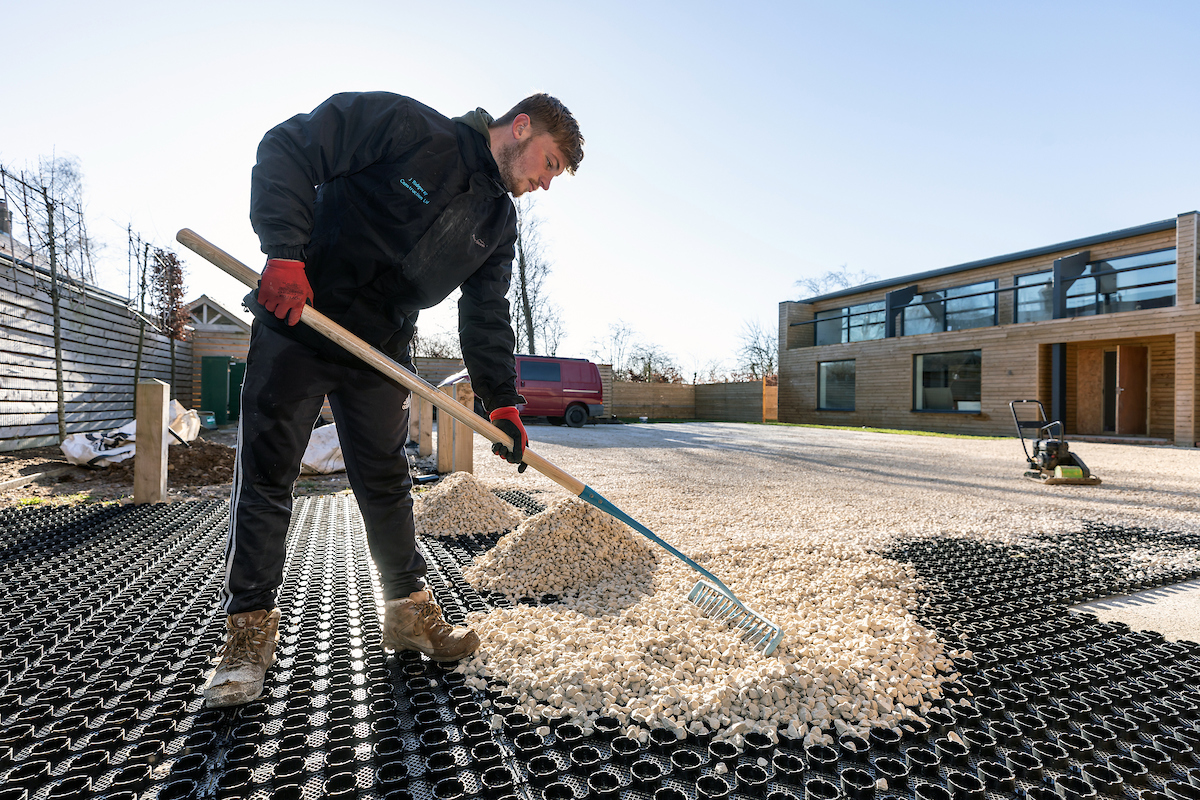
Some systems need individual pieces to be positioned and secured, while modular clip-together systems can simplify installation across larger areas. Check whether the product requires specialist tools, pins, edging or professional installation.
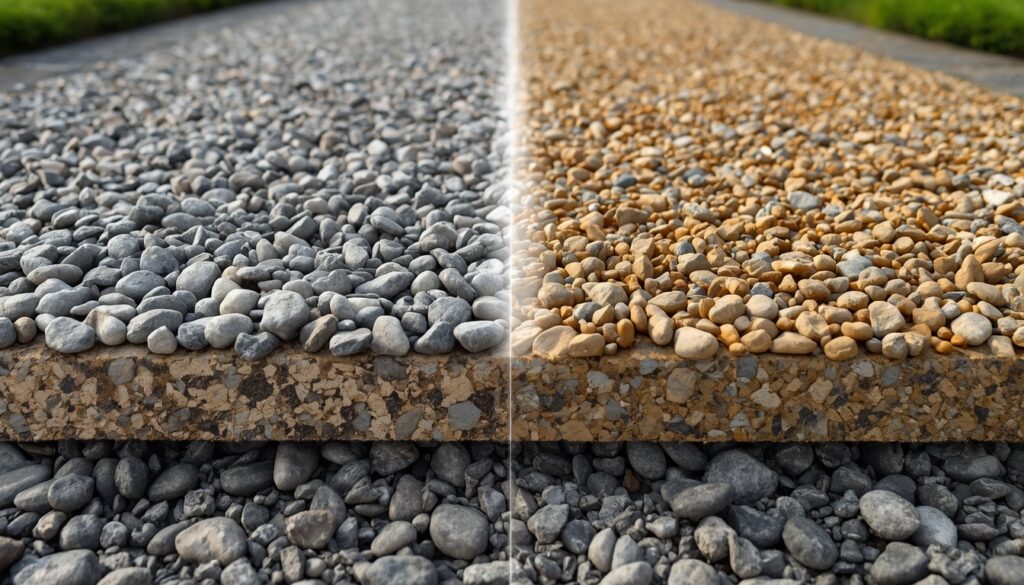
Appearance is an important consideration for many residential driveways. Some stabilisation products can remain visible through the gravel, particularly if the stone becomes displaced or the cells are not filled to the recommended level.
If maintaining a traditional gravel appearance is important, look for a system designed to remain concealed beneath the finished surface.
Gravel surfaces are often chosen partly for their permeable characteristics, but drainage performance depends on the complete driveway construction.
Check the manufacturer’s guidance and consider the sub-base, ground conditions and local drainage requirements rather than assuming that every gravel mesh or matting system will perform identically.
Before choosing between gravel mesh, gravel matting or another stabilisation system, compare the actual specifications.
This comparison gives you a more reliable basis for choosing a system than the product name alone.
The design of the stabilisation system determines how effectively it keeps gravel in position.
A suitable grid should restrict lateral movement while allowing the gravel to form a stable, usable surface above it. Cell shape, depth, material strength and how the system connects to adjacent sections can all affect performance.
For driveways, this becomes particularly important around turning areas, entrances and other points where vehicles repeatedly change direction. Without adequate stabilisation, these areas can experience greater gravel movement and rutting.
The sub-base still plays a critical role. Even a well-designed grid cannot compensate for inadequate ground preparation.
Most gravel stabilisation systems ask you to accept some form of visible grid as part of the finished surface. Gravelrings® takes a different approach.
Its circular, closed-cell mesh base locks gravel laterally while sitting entirely below the finished level. Once installed and filled correctly, the stabilisation system is concealed beneath the gravel, leaving the surface looking like traditional loose gravel rather than a visible plastic grid.
That makes the system particularly relevant where the appearance of the driveway matters alongside stability. Traditional properties, approach drives and other areas where the driveway forms part of the overall architecture can benefit from a surface that retains the natural appearance of gravel without giving up stabilisation.
Gravelrings® is designed and manufactured in the UK and is rated to support loads of up to 350 tonnes per square metre. Beauxfort also states that the system uses around 30% less gravel than most conventional loose-gravel applications, which can reduce the amount of aggregate required for a project.
As with any driveway system, performance depends on appropriate ground preparation, installation and material selection.
The comparison between gravel mesh and gravel matting ultimately comes down to the specification and the requirements of your project.
If your priority is simply finding a way to stabilise gravel, there are several systems worth comparing. But if you need a driveway that combines vehicle-load performance, gravel retention and a traditional finished appearance, the design of the stabilisation system becomes much more important.
Gravelrings® is designed around that combination. The concealed closed-cell mesh keeps gravel in place without leaving a visible grid pattern across the finished surface.
For homeowners looking for a stable gravel driveway without changing the character of the property, that removes one of the main compromises associated with visible gravel grid systems.
To estimate the amount of gravel required for your project, use Beauxfort’s Project Calculator. You can also explore its gravel grid solutions or contact the team for further guidance.